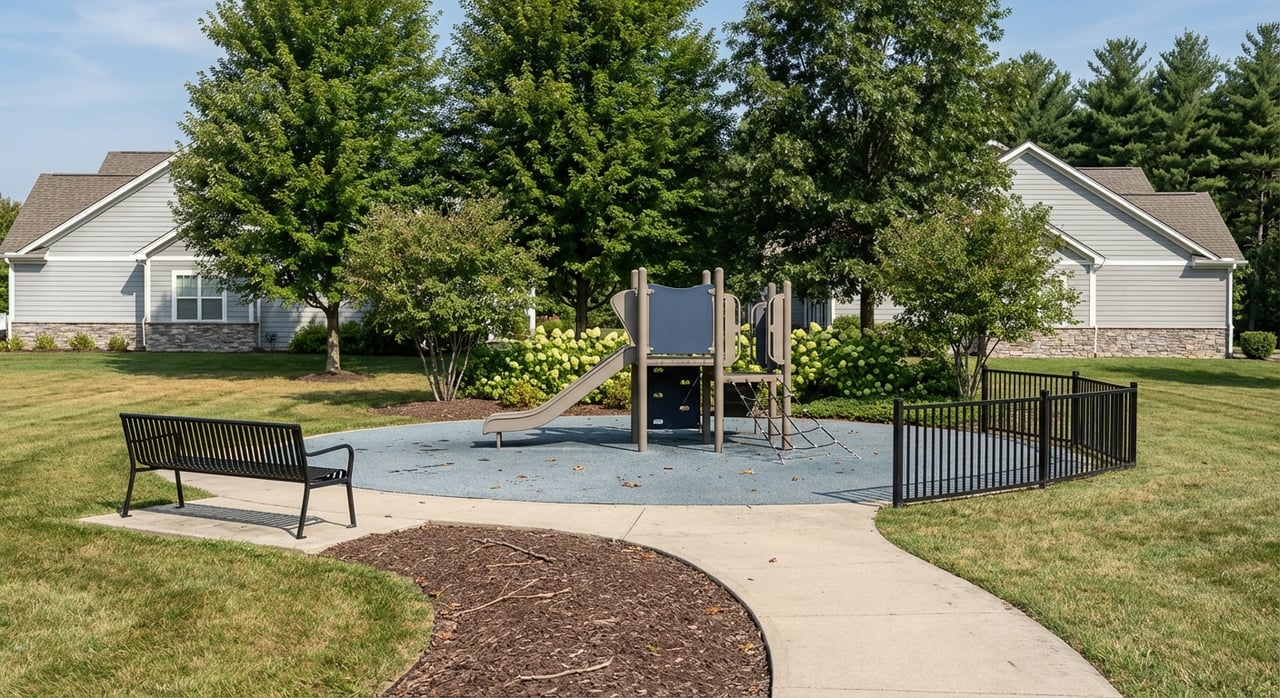
Drive down Geyser Road in Milton Center this month and you'll notice two things that weren't there in August. A fenced dog run with separate sides for big dogs and small ones now sits at 503 Geyser Road, and a rebuilt playground stands nearby at Burgess-Kimball Memorial Park. Both opened the same Saturday, September 12. The dog park is new, but it occupies the former playground site.
That's not a coincidence. It's how this town operates, and once you see it at the Bark Park, you start seeing it everywhere in Milton.
A Playground Site That Got Reassigned
The Town's own parks page lays out the move plainly. The Doc Blaisdell Bark Park transforms the former Burgess-Kimball Memorial Playground site into a new recreational space, and it does so by taking advantage of the site's existing fencing, utilities, parking, and its connection to the Milton Mile Trail. Nothing about that sentence describes new construction from the ground up. It describes an inheritance. The fence posts, the parking spots, the trail link, all of it belonged to the old playground first, and the Town simply handed the same footprint a new job.
The Town calls this the Reimagine Milton vision, and the phrase is doing real work. It isn't a slogan about growth. It's a description of how Milton keeps expanding its recreation options without expanding its footprint. A few miles away, Wood Thrush Court got the Suzanne Lyall Playground earlier this year, an all-inclusive design meant for kids of every ability. That one is new ground. But the more Milton pattern, the one that shows up again and again once you start looking, is the Bark Park move: take something that already has utilities running to it, and give it a second life.
The Pond That Used to Supply Water to the Town
Woods Hollow Nature Preserve is a particularly clear example of this pattern. Walk the loop today and you'll pass a placid lake with a wooden dock and, next to it, a pump house that's stopped pumping. That lake wasn't built for recreation. It was the local water supply before it was a trail destination, and the pump house standing next to it is the leftover proof.
The Town didn't build this preserve from scratch either. Milton and the Village of Ballston Spa jointly purchased the 130-acre tract through a letter of intent, funded in part through a sale of land to the Community Emergency Corps and a Saratoga County Open Space Preservation Grant. The goal, according to the Town's own announcement, was to protect the land from development and manage it as forest rather than build anything new on it. The trails that wind through today, including the stretch past the lupine fields that support the karner blue butterfly, follow old logging roads rather than newly cut paths.
Here's what that means if you use the preserve regularly: the informal, sandy-soil feel of the trails isn't rustic styling. It's because you're walking former infrastructure, repurposed rather than redesigned.
A Corner of Middleline and Geyser That Already Existed
Invasion Park is the smallest example, and maybe the clearest one. To mark the 250th anniversary of the American Revolution, the Town designated the southeastern corner of Middleline Road and Geyser Road as Invasion Park, recognizing the historical significance of the 1780 Raid on Ballstown. There's no new monument here, no visitor center. The Town took a corner of land it already owned in Milton Center and gave it a name tied to something that happened on or near that ground nearly 250 years ago.
Here's what the three sites have in common, laid out plainly:
| What it used to be | What it is now |
|---|---|
| Former playground site at Burgess-Kimball | Doc Blaisdell Bark Park |
| A private water reservoir | Woods Hollow Nature Preserve's fishing pond |
| An unmarked road corner in Milton Center | Invasion Park |
Three different departments, three different timelines, the same instinct. Milton doesn't clear land. It reassigns it.
Two Miles Down Rock City Road, the Mill Never Stopped to Be Reassigned
Then there's Cottrell Paper Company, and this is where the pattern gets its oldest and most literal expression. The mill sits on Rock City Road in the hamlet of Rock City Falls, in a stone building that once belonged to George West, the paper bag manufacturer whose mills lined the Kayaderosseras Creek in the 1800s. Frank Cottrell Sr. bought into that same building in 1926 with his two sons, and the business he started has never left it.
What makes Cottrell's story fit the Milton pattern isn't the building. It's the raw material. From day one, the company made paper out of scrap denim and cotton clippings, turning waste into product decades before sustainability became a marketing term anyone reached for. This past January, the state of New York added Cottrell Paper Company to its Historic Business Preservation Registry, a recognition for a business that's operated continuously in the same spot for a full century. Fourth-generation owner Joshua Cottrell, who now runs the mill with his brother James, described his great-grandfather's founding idea in a WAMC report:
"I have an idea to make cotton paper out of denim blue jeans."
That was his great-grandfather's pitch to a paper company that wasn't interested, so he built his own mill instead. A hundred years later, the mill still runs on the same principle. Nothing gets thrown away if it can be turned into something else.
The Pattern Underneath the Fall Calendar
Put these four things next to each other and a single thread runs through all of them. Milton's Town government doesn't announce new construction very often, and when you look at what's actually opened or been recognized in 2026, almost none of it is new ground. The Bark Park reused a playground's utilities. Woods Hollow reused a reservoir's footprint. Invasion Park reused a road corner it already owned. Cottrell Paper Company has been reusing raw material since 1926, and the state just noticed.
This matters for anyone who lives here and wants to understand where the town is putting its attention this fall. It isn't spending on brand new parkland or brand new commercial development. It's spending on connections between things it already has, wiring the Bark Park into the Milton Mile Trail, keeping Woods Hollow's old logging roads walkable, and letting a hundred-year-old business earn a state designation for never having moved.
If you're the kind of resident who walks a dog at the new Bark Park this fall, or takes the Woods Hollow loop past the lupine fields, or drives past the Cottrell mill on Rock City Road without knowing what's inside it, you're looking at the same town logic three different ways. Milton doesn't clear space for what's next. It finds a second use for what's already standing.
If you're curious what a house on one of these repurposed corners of Milton is actually worth today, or want a straightforward read on what's for sale near Rock City Falls or Woods Hollow this fall, Julie Ann Gold knows this town road by road and is glad to walk you through it.